
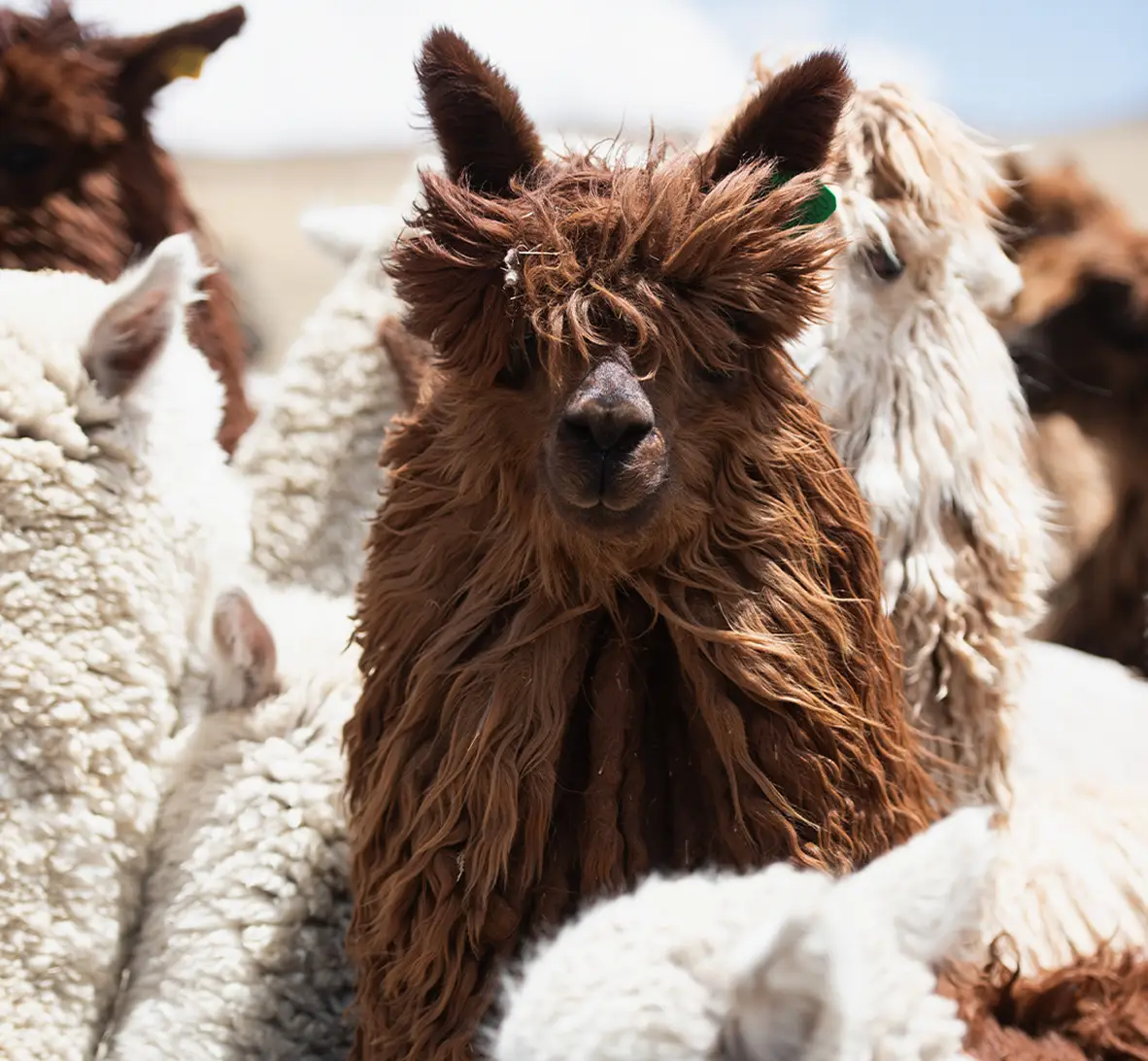
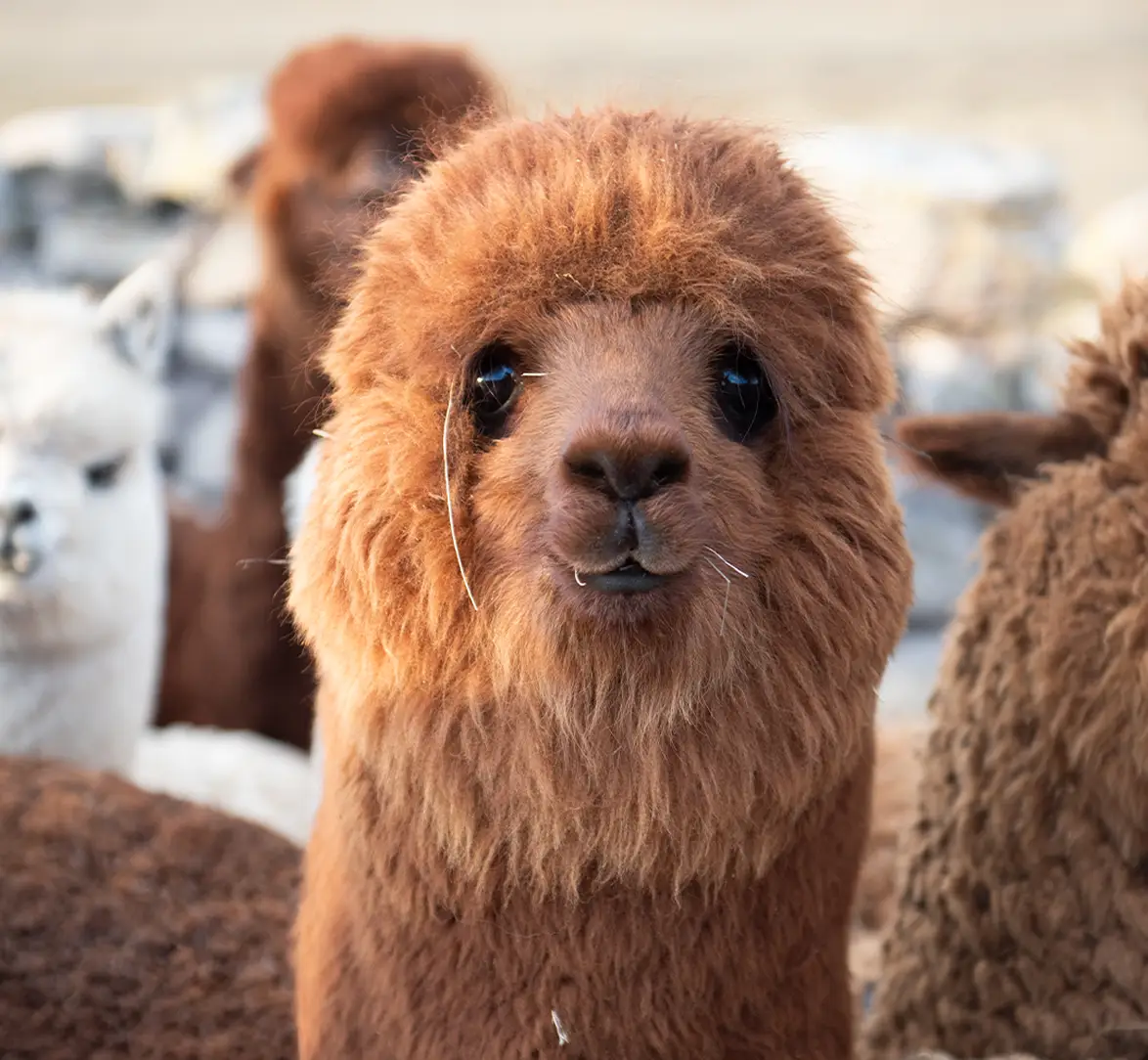
The alpaca, whose scientific name is Vicugna pacos is the South American camelid with the largest population. It lives predominantly in the southern Peruvian Andes, where approximately 80% of the world’s population is found divided into two breeds: Huacaya and Suri..
Domesticated since time immemorial and regarded as an essential part of high-Andean culture, the alpaca stands out for its fine and alluring fleece, which was prized in ancient times and reserved exclusively for the Inca imperial family.
It is a graceful animal, harmonious in its movement, with a slender body covered in fibre collectively known as the fleece. It is also considered environmentally friendly: its soft footpads do not damage pastureland nor cause soil erosion, and its naturally occurring range of colours makes it a renewable natural resource that sustains a truly sustainable value chain.
South American Camelids
A unique diversity that brings high-Andean culture to life
South American camelids are an essential part of the history and ecosystem of the high Andes. They represent not only a source of fibre and sustenance, but also a cultural and environmental legacy that has supported Andean communities for centuries. Among them are both wild and domestic species, each with unique characteristics that reflect the diversity and richness of the Andes.
Wild South American Camelids
Vicuña: Scientific name, Vicugna vicugna.
Guanaco: Scientific name, Lama guanicoe.
Domestic South American Camelids
Alpaca: Scientific name, Vicugna pacos.
Llama: Scientific name, Llama glama.
Andean Fibre
A natural fibre with unique and incomparable benefits
Alpaca fibre is recognised worldwide for its versatility, softness, and sustainability. Its natural qualities make it an exceptional textile material, highly valued in fashion, design, and industry for its distinctive characteristics.

Variety of natural colours
Alpaca fibre offers more than 20 natural shades, avoiding the need for dyeing processes.

High durability
It withstands the passage of time without being damaged by moisture or microorganisms.

Eco-friendly
Alpacas graze without uprooting plants, helping the ecosystem regenerate.

Hypoallergenic properties
Ideal for people with sensitive or allergic skin. The fibre contains no lanolin.

Thermal properties
It retains body heat effectively thanks to the air trapped within the fibre.

Elasticity and tensile capacity for spinning
Its uniform natural crimp allows for flexible, strong, and continuous yarn.

Soft feel
Naturally smooth and soft due to its structure and moisture content.

High efficiency
Alpacas require less feed than other animals that produce similar fibres.

Non-flammability
The fibre does not ignite unless in direct contact with flame.
Production Process
From the Andes to the World
Alpaca fibre undergoes a rigorous production process that ensures its quality and transforms this raw material into highly valued products for the international textile industry.
Breeding
This is the first link in the production chain, carried out largely by farming families living in the high-Andean regions of Peru. It includes aspects of productive and reproductive management, nutrition, genetic improvement, and animal health.
From this link comes the alpaca fibre that gives rise to all subsequent stages of the production chain. It is therefore strategic and of the greatest importance.
Shearing
This consists of properly cutting and separating the fleece from the alpaca once it has reached the appropriate length. From one year of age onward, herders obtain the animal’s fleece annually.
Categorisation
Each stage of the value chain ensures the quality and sustainability of alpaca fibre, transforming it into an exceptional textile material recognised by the international industry.
Classification (Sorting)
The fleeces are carefully separated by specialised personnel according to fineness, length, and colour ranges.
Industrial process
The fibre undergoes the following industrial processes:
Washing: removes all grease and foreign matter from the fibre.
Carding: transforms it into a regular and uniform sliver.
Combing: This stage eliminates any remaining vegetable impurities and removes short fibres to form the so-called “tops.”
Spinning The “tops” are gradually reduced in fibre weight until they become yarn.
Dyeing: the yarns can be dyed to the desired colours.
Weaving and garment making
The yarn is transformed into fabric (woven or knitted) for the production of value-added items such as garments, accessories, home textiles, and more.
Distribution and commerce
Finally, the products are marketed in national and international markets through various distribution channels such as shops and trade fairs, which involves the implementation of marketing and brand-development strategies.
Each stage of the production process ensures the quality and sustainability of alpaca fibre, transforming it into an exceptional textile material recognised by the international industry.
Why Choose Alpaca?
A noble fibre that unites sustainability, culture, and excellence.
Alpaca fibre is a clear example of how a natural raw material can align environmental, social, cultural, and economic values within a regenerative bioeconomy.
The alpaca originates from high-Andean ecosystems, where it evolved over thousands of years as part of an ancestral production system that encompasses cultural heritage while promoting ecological, economic, and social sustainability.
It provides work and income for thousands of families and offers us a noble natural fibre highly valued for its textile qualities.
Alpacas Are Environmentally Friendly
- Alpaca breeding systems coexist in harmony with high-Andean ecosystems; they do not require intensive water use, and no synthetic fertilisers are employed.
- Alpaca breeding is considered low-impact extensive livestock farming and is vital for the conservation of Andean grasslands, soil carbon sequestration, and the climate resilience of rural communities.
- Andean ecosystems are inhospitable, fragile, and characterised by poor soils and sparse pasture. The alpaca transforms these scarce natural Andean grasses into a noble and highly valued fibre.
- Alpacas cut pasture with their incisors rather than uprooting it, allowing the flora of high-Andean ecosystems to regenerate naturally.
- Alpacas have a physiological behaviour similar to cats; they tend to defecate and urinate in specific dung piles and sleeping areas, allowing their waste to accumulate in designated spots, which makes it easier for breeders to manage it as natural fertiliser.
- The base of an alpaca’s feet is covered with soft tissue, similar to a dog’s paws. Unlike other ruminants with hard hooves, alpacas do not damage or erode the soil.
Alpacas Represent Millenary Legacies
- The first camelids arrived in the Andes 3 million years ago. Five thousand years ago, the alpaca was domesticated by pre-Columbian communities. Together with the llama, the guinea pig, and the creole duck, the alpaca forms part of South America’s native livestock heritage, serving as an important source of food and clothing for Andean populations over millennia.
- According to the Andean Cosmovision, “Pachamama” gave origin to humans and animals and ordained that they live in perfect harmony. For this reason, the alpaca is cared for and honoured, as it provides the foundation of family livelihoods.
- The fibres of South American camelids—alpaca, llama, vicuña, and guanaco—together with cotton, formed the basis of pre-Columbian textile art.
- In ancient Peru, textiles were an intrinsic expression of culture, fulfilling various social, economic, and religious functions.
- The combination of designs and colours used to create textiles that met everyday needs evolved to achieve levels of technical and aesthetic perfection that continue to captivate us to this day.
Alpacas Are the Livelihood of Thousands of Families
- According to the Ministry of Agriculture and Irrigation of Peru (MIDAGRI), more than 94,000 families are dedicated to alpaca breeding, located in the central and southern highlands of the Peruvian Andes.
- It is the only economically viable activity above 4,000 metres above sea level.
- The alpaca textile chain generates more than 150,000 jobs, including breeding, fibre supply chains, industrial processing, garment manufacturing, and handicrafts.
- It is a successful model of a vertically integrated textile chain, encompassing more than 80% of the world’s alpaca population, industrial companies, and a textile–garment cluster made up of more than 600 micro and small enterprises.
Alpacas Produce an Extraordinary Textile Fibre
- Alpaca fibre is naturally renewable and biodegradable, and its environmental impact is significantly lower than that of synthetic fibres or even certain industrially processed natural fibres.
- Unlike petroleum-derived materials, alpaca fibre can return to the earth at the end of its life cycle within just a few years, without generating toxic waste or contributing to microplastic pollution.
- Alpaca fibre offers 9 pure colours and more than 20 natural shades, reducing the need for industrial dyeing and resulting in substantial savings of water and energy.
- Significant progress has been made in dyeing white fibre, allowing the use of entirely natural dyes and colourants that bond to the fibre easily and with long-lasting results.
- One of the most remarkable characteristics of alpaca fibre is its thermal capacity. Its adaptability is such that, when one feels cold, a garment made from this raw material provides warmth, and when it is hot, it feels light.
- This allows alpaca garments to be worn in any season of the year and in most climates.
- Another key characteristic of alpaca fibre lies in its durability, elasticity, and strength, enabling long-lasting products that promote responsible consumption and waste reduction.
- Its hygroscopic property is also important, as it prevents the garment from absorbing moisture.
- Its low flammability makes it suitable for use in the manufacture of home décor products.
RAS: Committed to the Well-being of the Alpaca and Its Environment
The Responsible Standards for animal fibres, such as RMS (Responsible Mohair Standard) and RWS (Responsible Wool Standard), were created by Textile Exchange and endorsed by international textile brands.
In the case of RAS, it was developed and reviewed by an International Working Group made up of breeders, processors, researchers, and representatives from public and private institutions connected to the global alpaca textile sector.
The International Alpaca Association (AIA), together with its technical partner, the Asociación Civil Alpaca del Peru (ASCALPE), was part of this Working Group.
Comprehensive certification for the entire Alpaca value chain
RAS requires the certification of all links in the value chain — from alpaca production centres and textile processing units to the seller involved in the final business-to-business transaction.
RAS breeders are assessed according to the animal welfare, land management, and social well-being requirements established in the standard.
The progress of RAS in Peru as of 2025 is as follows:
implemented and certified production units.
processing companies already certified.
combing plants
spinning plants
garment-manufacturing plants
certification bodies active in Peru.
RAS Implementers (technicians and breeders), in a programme driven by AIA and ASCALPE, ensuring successful inclusion of small breeders through technical support and internal control.
RAS in Peru is moving forward with strength, integrating sustainability, animal welfare, and social development.
It stands as a model of reference for the global alpaca sector.